
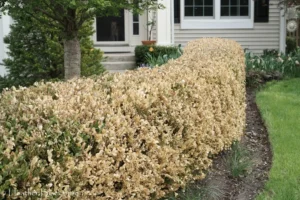
 Plant damage can be caused by a number of factors, some we can’t control…
Pale pink hydrangeas, grassy green boxwoods, rosy red azaleas. There’s a perfect shrub to match any landscape color scheme.
Brown shrubs, though? They don’t quite have the same charm. More importantly, a once healthy shrub that’s now dull, dry and brown is likely in trouble, and it needs a little TLC to get back to its old self.
If your shrubs switched up on you, keep reading to find out how to step in and save them.
How do I tell if my tree or shrub is dead?
This may seem a silly question but it is not always obvious. Deciduous trees look dead in the winter when their stems are bare of leaves, for example.
When you suspect a plant is dead but are not sure, take the following test;
- Scratch the bark (the “scratch test”) on the shoots of your trees or shrub with your thumb nail or a penknife. A stem with green under the bark is alive; a stem with brown under the bark is dead. Living shoots also tend to have smooth, firm bark, whereas dead or dying shoots tend to have flaking, peeling or wizened bark.
- Where the shoots are dead at the tips, repeat the test on thicker wood to see if that is also dead. Where most or all of the upper parts of a plant are brown under the bark, the plant is most likely dead.
- A final test is to scrape the bark of the main stem just below the soil line or on the roots themselves. If this appears dark in colour, especially with any sign of soft, rotting roots, then you can be confident your plant is dead.
Plants that still show some signs of life (e.g. green under the bark or a firm rootstock) could be left for a few months or until spring to see if they improve. If they continue to deteriorate or simply fail to come into growth in the spring, assume they are dead.
 It would be wonderful if every plant we have thrived. However, as every experienced gardener or homeowner knows, sometimes plants do sadly die and there are a number of reasons why.
Common reasons new trees or shrubs fail
The first two growing seasons after planting are a critical time for a tree or shrub. Unless it gets its roots successfully established into the surrounding soil, it will be prone to failure particularly in times of stress such as during drought or waterlogging.
ESTABLISHMENT FAILURE- Plants that die within the first year after planting are most likely to have failed to establish. Their roots will most likely be dead or stunted. When digging the plant out look for signs of;
- Too wet – wet season, wet soil or overwatering. Remedy: Check the soil around new plants for standing water or waterlogged conditions. Reduce watering where necessary (remember plants in the ground do not need to be watered as frequently as those in containers). Choose plants more suited for wet conditions
- Too dry – dry season, dry/unimproved soil or erratic/insufficient watering. Remedy: Thoroughly wet the rootball on planting; if the compost or soil repels rather than absorbs the water, add a few drops of washing-up liquid into the watering can to act as a wetting agent. In the first growing season check all new plants weekly for signs of drying, especially in dry weather. water thoroughly (applying sufficient to wet the full depth of rootball) at the first signs of the soil drying. Choose plants more suited for dry conditions
- Planted too deep – causes rotting of stem base; a common failure of woody plants. Remedy: Avoid deep planting by positioning the tree or shrub with the first flare of roots (thicker roots, not the fine adventitious roots) just below the soil line. Scrape away the soil or mulch from the base of trees and shrubs suspected of deep planting
- Undeveloped roots that have failed to grow out into the surrounding soil – caused by compacted rootball that was not trimmed or loosened (‘teased out’) on planting, a restrictive root wrapping material or compacted surrounding soil. Remedy: Trim potbound rootballs prior to planting to encourage lateral root growth. Remove root wrappings unless stated otherwise by the nursery. plant trees and shrubs using good techniques (i.e. dig out a hole one times the depth and three times the width of the rootball) to ensure soil compaction is alleviated. In post-planting cases of suspected soil compaction, carefully loosen a ring of soil to the outer edge of the rootball using a border fork. Congested roots can be trimmed in the dormant season or spring
- Unsuited to site conditions. Some plants are not too fussy about their environment but others will suffer if given the wrong conditions. A plant in the wrong place can quickly fail. Remedy: Check before planting the preferred soil texture (well-drained, moist, etc), pH and degree of sun or shade for your tree or shrub and site it accordingly.
- Animal damage. Plants in the ground can get nibbled by wild animals. Although rabbits and deer are mostly troublesome in rural and semi-rural gardens, mice and voles can be found in all gardens. Look for patches of stripped bark on the lower sections of woody plants, especially in winter and the sudden disappearance of stems and foliage of herbaceous plants, usually in spring and summer. Remedy: Where rabbits or deer are likely to be a problem, fit all newly planted trees and shrubs with spiral guards, enclose individual plants or beds in chicken wire or choose plants that are more resistant to damage; check all new plants for mice or vole damage and clear away cover where possible.
Common reasons well established trees or shrubs fail
Plants that have been in the ground some years, having put on growth and appeared healthy before dying are most likely to have died of a disease picked up from the soil or a major physical/environmental stress.
Wind, sun or cold damage
All plants have their limits and may be caught by extremes of weather.
Remedy: Check the growing conditions of your plant to see if it requires protection from wind, sun or cold and position or protect it as required. Fortunately, many trees and shrubs often recover from weather damage, especially if only the exposed side(s) is damaged so cut the damaged parts out and wait until the growing season to give it the benefit of the doubt.
Soil borne diseases
Plants can pick up diseases from gardens soils or other plants. While there are many weakening and unsightly diseases that cause problems for the foliage such as rusts, scabs and leaf spots, these do not usually lead to the demise of the plant. Instead, it is the root diseases that are most to blame for the loss of established plants. Most commonly encountered are;
- White rot – this can be identified by the presence of creamy-white fungal sheets (mycelium) under the bark of the base of the stem or roots of an affected plant. Remedy: Dig out the dead or dying plant and bin or burn. Avoid replacing with susceptible plants in that area
- Root rot – as this is a disease caused by a microscopic fungus-like organism, the only visible sign is a plant with dead or rotting roots. Remedy: Dig out the dead or dying plant and bin or burn. Avoid replacing with susceptible plants in that area
- Verticillium Wilt– dark (black) staining can be found under the bark of shoots that have died back as a result of this infection. Remedy: Dig out the dead or dying plant and bin or burn. Avoid replacing with susceptible plants in that area
Growth diseases or disorders
A number of specific diseases or disorders that affect the upper parts of plants (trunk, stems and leaves) can be severe enough to kill, permanently weaken or make so unsightly that removal of the affected tree or shrub is sometimes best.
Root disturbance or damage
Trees and shrubs that have been moved do not always re-establish successfully and some woody plants such as broom and magnolia resent root disturbance at any stage.
Remedy: If moving established trees and shrubs is necessary, move them at a favourable time of year (autumn or spring for evergreens; when not in leaf for deciduous) and ensure they are kept well watered in the subsequent growing season.
Additionally, the roots of trees and shrubs can extend far into the surrounding soil. Major disturbance such as trenching, building work, drainage work, and patio or driveway construction that damages the roots of nearby plants can lead ultimately to their death. The other main cause of damage to roots is where the soil is compacted through heavy machinery or soil levels are changes suddenly, burying part or all of a root system.
Remedy: Minimise the impact of root damage to plants during ground work, especially in the growing season. Excavating by hand can help save large roots or for more extensive work near trees use an air knife to remove soil without cutting through rotos. Avoid changing soil levels around established plants or lift and replant/replace where necessary.
Prolonged drought or waterlogging
Unless a plant is known to tolerate drought or wet soil conditions, extended periods of either can put plants under stress and, in some cases, lead to plant death.
Remedy: Consider watering and mulching smaller plants during extreme drought and always keep containerised plants well watered in dry weather. After a period of waterlogging or flooding, especially in the growing season, try aerating the soil and assess whether drainage or flood defences are required.
What to do with a dead plant
Dead plants are best removed, to minimise possible sources of infection to neighbouring plants and to create space for replanting. Aim to;
- Dig out the plant and as much of the stump and thicker roots as possible, using a stump grinder for larger stumps
- Bag it up and take it to your nearest waste disposal site
- Alternatively, let the plant dry out and burn it in a bonfire or incinerator (woody plants with little soil on the roots burn best). However, burning creates pollution and may also annoy neighbours. Fires should be conducted when wind and weather mean that smoke will not enter houses or inhibit others from enjoying their garden.
If you know the plant had a soil borne disease such as root rot consider removing soil from the root run and replacing with new topsoil or soil from an unaffected part of the garden. Take the affected soil to the tip or make use of it in the vegetable garden where there are unlikely to be susceptible plants. Soil replacement is only feasible with relatively small plants.