
A guide to selecting the right turf for you
 First Things First…
What is Cool and Warm Season Grass?
To me a lush carpet of pine needles or spongy grass is more welcome than the most luxurious Persian rug. – Helen Keller
Cool-Season grass
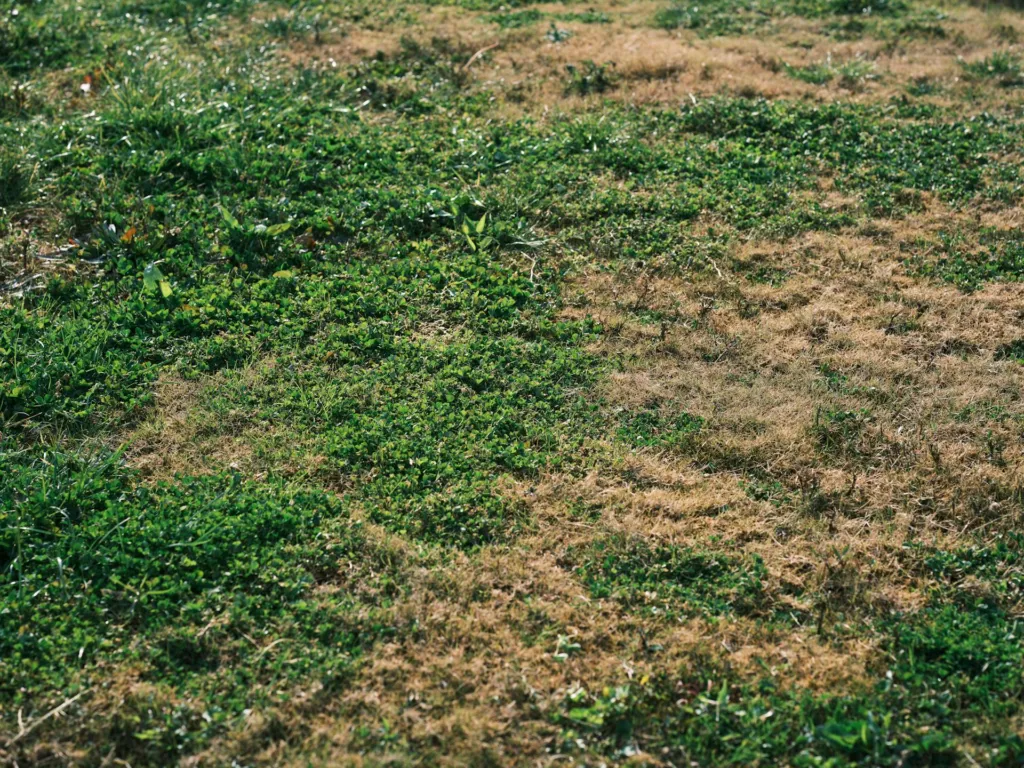
Cool-season grasses typically grow in the North, where winters are cold and summers are mild. Hot summers are the main hurdle for cool-season grasses: As temperatures warm up, they require more photosynthetic energy to stay green. When summers are too hot, cool-season grass can sustain permanent damage, perish, or go dormant (turn brown).
Cool-season growing specifications:
- Growth begins when soil temperatures warm to 40-45 degrees Fahrenheit
- Ideal growing temperature: 65-75 degrees Fahrenheit
- Most vigorous growth periods: Early spring and fall
- Goes dormant in hot summers (over 90 degrees Fahrenheit)
- Grows less efficiently as temperatures rise: Requires more water in summer
- More cold-hardy than warm-season grasses
Common cool-season grasses:
- Annual ryegrass (Lolium multiflorum)
- Creeping bentgrass (Agrostis palustris)
- Hard fescue (Festuca ovina)
- Kentucky bluegrass (Poa pratensis)
- Perennial ryegrass (Lolium perenne)
- Tall fescue (Festuca arundinacea)
Warm-season grass
Warm-season grasses thrive in the South, where summers are hot and winters are mild. Winters can be stressful for warm-season grasses and they go dormant when temperatures drop too low. They’re highly efficient photosynthesizers and require less water than cool-season grasses.
Warm-season growing specifications:
- Growth begins when soil temperatures warm to 60-65 degrees Fahrenheit
- Ideal growing temperature: 90-95 degrees Fahrenheit
- Most vigorous growth period: Summer (July to September)
- Goes dormant in cold winters (below 50 degrees)
- More efficient at photosynthesis in hot weather
- Require less water than cool-season grasses
- More drought-tolerant than cool-season grasses
Common warm-season grasses:
- Bermudagrass (Cynodon dactylon)
- Buffalograss (Buchloe dactyloides)
- Centipedegrass (Eremochloa ophiuroides)
- St. Augustine (Stenotaphrum secundatum)
- Zoysiagrass (Zoysia japonica)
Where to draw the line?…..The transition zone.
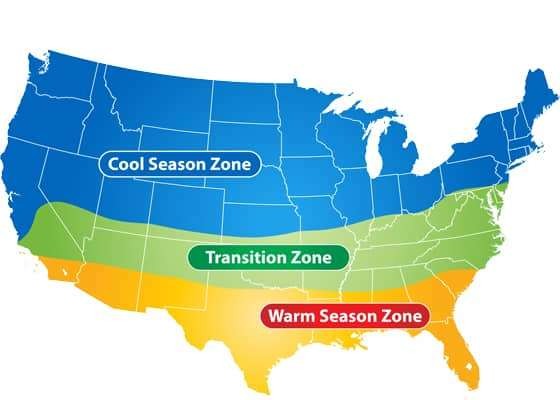
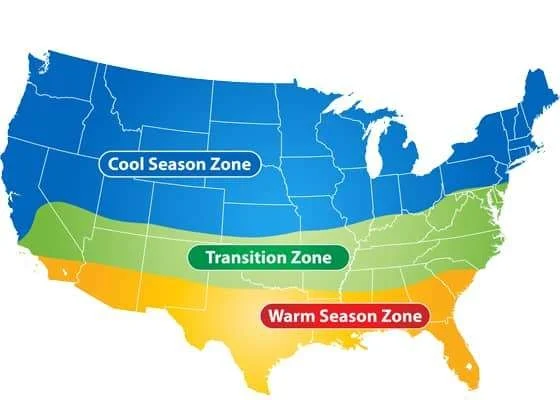
The Transition Zone is the belt of land sandwiched between warm and cool growing zones. It’s where lawns experience both scorching summers and freezing winters, making it tough to choose a turf type that won’t burn in summer or freeze in winter.
Instead of getting the best of both worlds, the Transition Zone sometimes gets a pretty raw deal. Warm-season grasses that thrive in the South can’t stand up to the Transition Zone’s cold winters, and cool-season grasses that grow in the North can’t deal with the hot summers.
In other words, it’s hard to get a year-round green lawn in the Transition Zone. You end up with either a lovely green lawn in summer and a brown one in winter, or a healthy lawn in winter and a wilted yellow one in summer.
What Grass to pick?
Warm-season grass for the Transition Zone
If you live in the southern portion of the Transition Zone, two types of grass will stand up to the heat and the cold: Zoysia and Bermuda.
Benefits of warm-season grass
- Requires less watering and maintenance than cool-season grass
- Fewer pest problems
- More disease-resistant
- Highly drought- and heat-tolerant
- More environmentally friendly
- Stands up to heavy summer foot traffic
- New varieties are cold-hardy
Disadvantages of warm-season grass
- Takes longer to green up in the spring
- More expensive to establish: Usually grown from sod
- Loses its color in winter
- May die if exposed to prolonged freezing weather
- Prone to thatch
Cool-season grass for the Transition Zone
The best cool-season grasses for the Transition Zone are tall fescues, fine fescues, Kentucky bluegrass, and perennial ryegrass.
Benefits of cool-season grass
- Less expensive to establish than warm-season grasses
- Generally more shade-tolerant
- High cold tolerance
- Won’t thin out in winter
- Ideal for shady lawns in the south!
Disadvantages of cool-season grass
- Loses color in summer
- Requires more water to maintain in high heat
- Requires re-seeding yearly to maintain thick turf