
Defend Your Home & Yard Against the Ants in Alabama
Spraying ants feels productive. However, the workers you’re eliminating are a small, replaceable portion of a colony that could number in the tens of thousands. So how do you get rid of ants in Alabama?
Real control requires a strategy of working back from the ants you can see to the colony you can’t. Then you remove the conditions that make your property worth returning to. The pest control professionals at TDI Services have mapped out that process below.
What’s Realistic to Expect With Ant Control?
Total, permanent ant elimination is nearly impossible to achieve. There are too many of them, they’re too widespread, and population pressure from surrounding properties makes it even more difficult.
What’s genuinely achievable? Sustained, long-term ant control. That means preventive yard baiting at the start of spring before colonies are fully active, regular perimeter treatments during warm weather, consistent sanitation and structural maintenance, and prompt attention whenever early signs reappear.
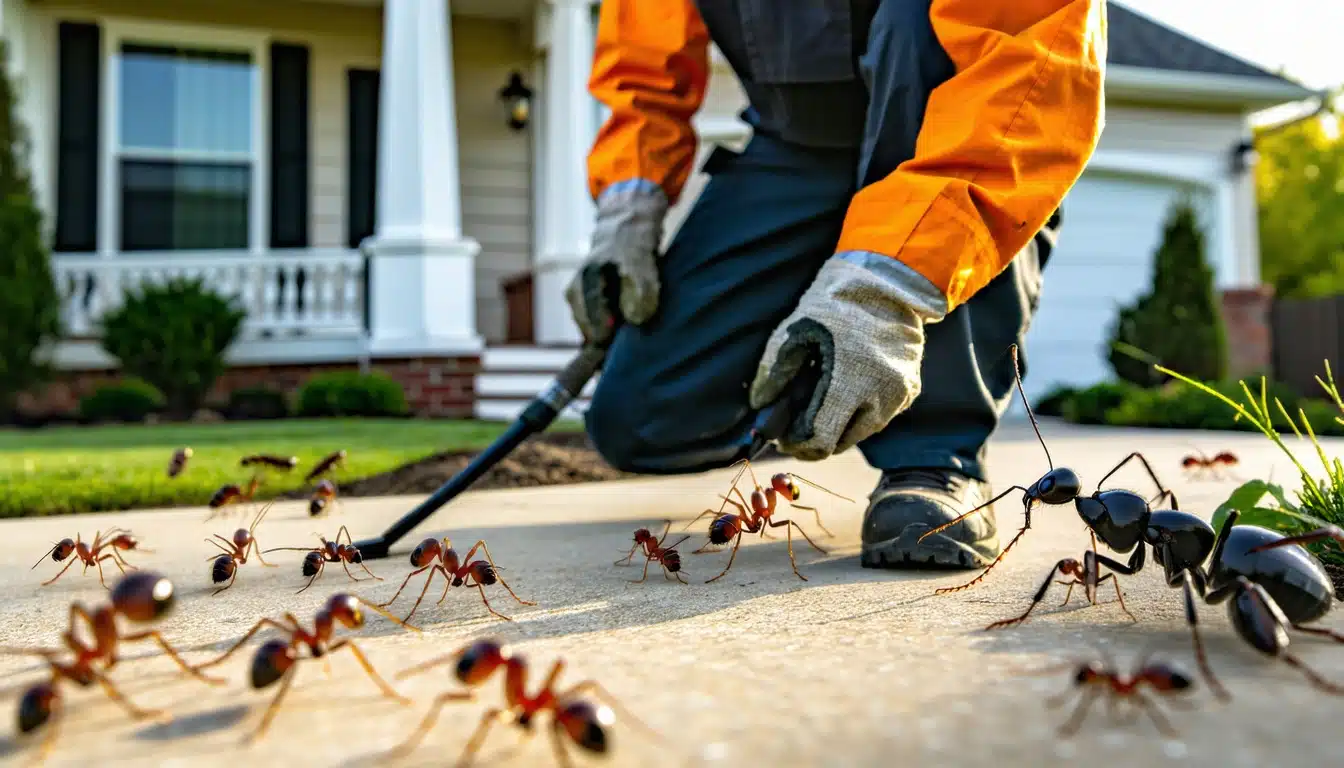
Step 1: Identify the Ant Species
The most common reason DIY ant control fails is treating the wrong species the wrong way. Ant behavior, nesting preferences, and bait responses vary significantly from one common ant species to the next.
Take pharaoh ants. Applying a repellent spray near an active pharaoh ant colony doesn’t kill it. It signals danger, causing the colony to split into multiple groups. Knowing your species beforehand prevents exactly that kind of setback.
Dietary preferences differ by species, too. Some are drawn to sweets, others to protein or fat. Nesting habits vary just as widely, from ants that live exclusively outside and forage indoors, to others that nest inside wall voids, beneath flooring, or behind baseboards.
Verify it’s an ant and not a termite
These two insects are frequently confused, particularly during swarming events. Ants have a narrow, pinched waist between the thorax and abdomen along with antennae that bend sharply at an angle. Termites have a broad, consistent midsection without any waist narrowing, and their antennae are straight.
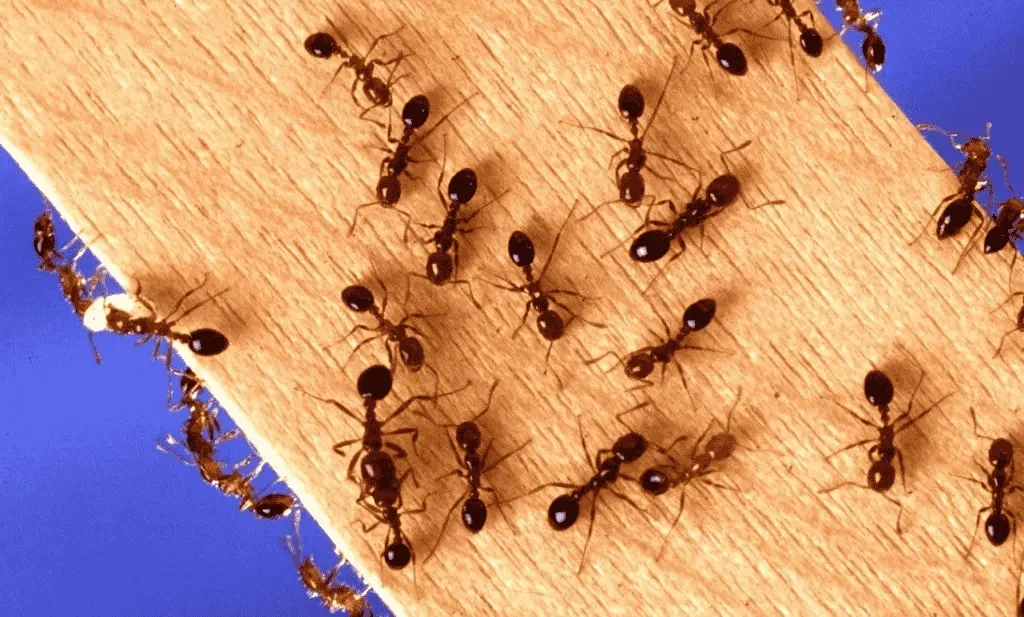
From there, species identification relies on size, color, odor, trail location, and nesting behavior. Looking at a combination of these characteristics together typically points clearly to one species or another.
Indicators of an infestation:
- Ant trails consistently following the same path along walls, floors, or countertops
- Ants repeatedly appearing in or near food storage areas
- New mounds forming in the lawn or within a few feet of the foundation
- Frass accumulating near wood signals carpenter ant tunneling
- Compromised food packaging
- A swarm of winged ants indoors or clustering around the home’s exterior
Don’t dismiss these as minor. Carpenter ants cause structural wood damage over time. Fire ants defend aggressively and their stings carry real medical risk. And regardless of species, an untreated colony keeps growing and spreading until it becomes considerably harder to address.
Locating the colony
Populations range from a few hundred to several hundred thousand, and nests can be almost anywhere. For instance, beneath the soil, inside a mulch bed, under a concrete slab, behind wall panels, or in deteriorating wood in your yard.
Timing matters as well. Spring brings colonies out of dormancy with foraging intensity at its highest. Summer is peak ant season. Fall shifts ant behavior toward heat-seeking, which often increases indoor pressure. Environmental swings can trigger rapid movement as colonies respond to changes in ground moisture, temperature, and available water.
Step 2: Take Away What Attracts Them
Ants are purposeful. A scout located food, water, or both inside your home and left a chemical signal to guide others back. Removing the resource ends the reason for the trail.
Start with food storage. Dry goods in their original cardboard or paper packaging are accessible to foraging ants without much effort. Move them into rigid, sealed containers.
Also, deal with spills and crumbs immediately, don’t leave dishes sitting in the sink, and make sure your garbage cans close tightly.
Keep in mind that water attracts ants just as much as food. Even a slow drip beneath a sink provides enough moisture to sustain a colony over the long term. So check under sinks, around the toilet base, near major appliances with water hookups, and in any area where condensation is a recurring issue.
Step 3: Clear the Chemical Trail
Ant foraging routes are pheromone highways. These are chemical signals left behind by workers that function as a precise navigation system for every ant that follows.
Breaking it up takes minimal effort. Wipe down trail surfaces using diluted white vinegar, warm water with a few drops of dish soap, or a standard glass cleaner. This degrades the pheromone layer and leaves returning workers disoriented.
However, trail disruption doesn’t affect the entire colony. Workers will explore, re-establish routes, and resume foraging as long as the source exists. So you should clear trails and then place bait.
Step 4: Stop the Colony, Not Just the Workers
Contact spray satisfies in the moment. Workers die, the trail vanishes, and it looks like it’s fixed. But the workers are replaceable. The queen cis still alive, so new foragers will come back within a few days.
Beyond that, repellent sprays create a secondary problem. The chemical signal they broadcast tells the colony that an area is compromised. Some species reroute their workers to avoid the zone. Others split the colony entirely, creating multiple independent nests in different locations.
What kills an ant queen? Bait.
Workers encounter bait on their trails, consume it, carry it back to the nest, and transfer it to the queen, larvae, and other colony members through normal feeding interactions. The active ingredient is slow enough that the colony distributes it widely before triggering any defensive response.
But formulation has to match the species. Sweet, liquid-based baits work on sugar-preferring ants, protein or fat-based options are necessary for species with different dietary profile, etc.
Placement guidance:
- Set stations directly on active trails
- Never apply repellent spray near bait
- A temporary increase in ant traffic around bait stations is normal
- Keep bait accessible for two to four weeks and replenish as needed
Step 5: Address the Source Outdoors
Treating only the interior of your home is treating a symptom. If the colony is established in your yard, workers will keep coming in regardless of what you do inside.
Outdoor areas to inspect:
- Foundation soil and mulch beds, especially where mulch contacts the siding
- Beneath rocks, pavers, or stacked landscape materials
- Potted plants and containers resting directly on soil
- Cracks and joints in driveways, patios, and sidewalk surfaces
- Firewood storage areas and deteriorating wood stumps
Outdoor treatment approach:
Follow foraging trails in the direction away from the house. Tracing them back often leads directly to the nest entrance.
Granular bait applied along foraging paths and near nesting areas is effective in outdoor settings. For perimeter protection, choose non-repellent products over repellent ones. Ants walk through the treated zone, pick up the active ingredient, and carry it back to the colony. Repellent treatments just redirect ants rather than exposing the colony.
Keep the area directly against the foundation clear. Pulling back mulch, loose soil, and dense groundcover by several inches removes the sheltered conditions ants prefer and makes it much easier to spot new activity.
Step 6: Block Every Route Back In
Once the colony is treated and the perimeter is addressed, sealing entry points is how you make sure the next season doesn’t look the same.
Entry points to check for ants in Alabama:
- Door and window frames, threshold seals, and deteriorated weatherstripping
- Baseboards that have pulled away from walls or floors
- Plumbing and utility penetrations under sinks and behind appliances
- Foundation cracks and transitions at siding edges
- Crawlspace vents, soffit vents, and gaps around exhaust fans
Seal gaps and cracks with silicone caulk. Install new weatherstripping where existing seals have compressed or cracked. Patch any torn screens. If carpenter ants are suspected, probe adjacent wood for soft spots.
On the landscape side, trim branches away from the roofline and siding, store firewood well away from the foundation, and keep mulch or topsoil from piling against the exterior walls. Each of these eliminates a pathway or a nesting site that would otherwise work against everything else you’ve done.
3 Natural Ant Control Methods
- Vinegar, essential oils, and soap-based sprays are useful for disrupting trails and killing workers on contact. They have no pathway to the colony, so they belong as supporting tools alongside bait.
- Borax bait is the natural option that works best at the colony level. Mixed at a low concentration with sugar water (or peanut butter for protein-preferring species), it behaves like commercial bait.
- Food-grade diatomaceous earth causes dehydration in ants that walk through it by damaging their exoskeleton. It functions best as a dry barrier near entry points, but loses effectiveness immediately when wet.
Ant Questions & Answers
-
Are spring infestations worse?
Yes, typically. Post-dormancy foraging is at its most intense, and colony populations are actively expanding after winter.
-
What actually kills the whole colony?
Slow-acting bait distributed by workers throughout the nest.
-
How long does bait take?
Most colonies show meaningful decline within one to three weeks. Larger, more established colonies take longer.
-
Can ants damage my home?
Carpenter ants can cause structural damage over time. Other species won’t compromise the structure but will contaminate food and expand until they’re addressed.
-
Why do they keep coming back?
Either an outdoor colony was never treated, entry points were never sealed, or neighboring colonies are producing seasonal reinvasion pressure.
-
Are natural methods worth trying?
For trail disruption near entry points, yes. For eliminating an established colony, bait is best for that.
-
Does bait draw more ants?
Temporarily, yes. That traffic is how the product reaches the colony, so it’s a sign the approach is working.
-
What method produces the fastest results?
Contact spray for immediate visible relief and bait with outdoor perimeter treatment for control that holds over time.
Ready to Get Rid of Ants in Alabama?
Follow these steps in the right order without skipping any of them: identify the species, cut off resources, clear the trails, bait the colony, treat the yard, seal the entry points. Every step builds on the one before it.
For professionals who deliver long-lasting ant and pest control, reach out to TDI Services in the Gulf Coast of Alabama. With highly trained technicians and industry-leading products, we’ll take steps to help achieve your dream yard.
Blog Contributor: Shawn Tate
Shawn Tate serves as the Hartselle Service Center Manager for TDI, with 13 years of experience. His professional perspective is shaped by lawn recovery, customer trust-building, technician development, and a genuine passion for the work. His experience gives him a strong understanding of how positive service, proper treatment, and team motivation can influence both customer outcomes and workplace culture.